We use cookies to improve your experience and our business. See our privacy/cookie policy or continue browsing to accept our use of cookies. View our cookie policy.

Do You Need to Insulate a Chimney Flue Liner? (2026 Expert Guide)
Installing a new stove or relining a chimney is a significant investment in your home’s comfort and safety. But one crucial decision often gets overlooked: whether to insulate the chimney flue liner. Many assume it’s an optional extra, but the truth is, insulation can be the difference between a perfectly performing stove and one plagued by issues.
This is your definitive 2026 guide for homeowners, professional installers, and DIYers installing a flexible flue liner. We’ll cut through the confusion and give you clear, expert advice.
The core question we’ll answer is: Should I insulate my flue liner? We’ll explore the pros and cons of chimney liner insulation, explain whether you need materials like Thermaflue or vermiculite, and help you make the right choice for your property, ensuring your appliance runs safely and efficiently for years to come.
What is Chimney Liner Insulation? (Clear Definition for Homeowners)
In simple terms, chimney liner insulation is a material placed in the gap between your new flexible flue liner and the inside walls of your existing masonry chimney stack. Its job is to keep the flue liner warm.
Think of it like a jacket for your flue liner. Without it, the hot gases travelling up the liner are rapidly cooled by the cold brickwork of the chimney. By insulating, you create a thermal barrier that keeps heat inside the liner, where it belongs.
There are two primary methods for insulating a flue liner:
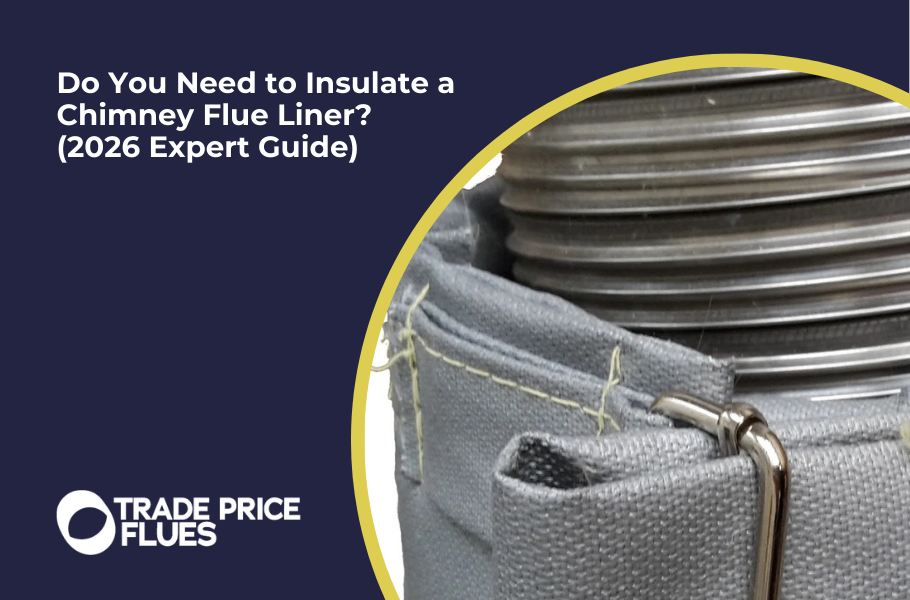
- ThermaFlue Chimney Wrap: This is a specialised high-temperature wrap. The inner wall of ThermaFlue comprises a durable, non-flammable, needle-glass fibre that provides excellent resistance and stability. The outer wall is constructed from a moisture-repellent, non-flammable silicone-coated material. The sum of these premium-quality components guarantees that ThermaFlue is warranted for at least 10 years. ThermaFlue is designed and tested to withstand long-term operational temperatures of up to 600 °C. It is suitable for use with all gas, oil and solid-fuel-burning appliances to which a flexible flue liner can be attached.
- Loose-Fill Insulation: This involves pouring lightweight, non-combustible granules, such as Vermiculite, Perlite, or LECA (Lightweight Expanded Clay Aggregate), into the voids around the liner after installation.
Here’s how it works in a nutshell:
Insulation → Keeps Flue Liner Hotter → Improves Flue Draught → Reduces Condensation & Tar Buildup
Why Insulate a Chimney Liner? The Key Benefits (With Real-World Impact)
Insulating your flue liner isn’t just about ticking a box; it delivers tangible improvements to your stove’s performance, safety, and longevity.
- Stronger Flue Draught: Hot air rises. The hotter the gases in your flue, the faster they will rise and exit the chimney. Insulation keeps these gases hot, creating a robust and consistent ‘pull’ or draught. This means your fire is easier to light and control.
- Lower Creosote and Tar Buildup: When hot flue gases hit a cold surface, condensation occurs. In a chimney, this moisture mixes with soot to form highly flammable creosote and tar. A warm, insulated liner dramatically reduces this condensation, keeping your flue cleaner, significantly reducing the risk of a chimney fire, and making sweeping easier.
- Stops ‘Smoke Rollback’: A poor draught, caused by a cold flue, can slow and cool gases, causing them to backdraft into the room through the stove vents or door. This ‘smoke rollback’ is unpleasant and dangerous. Insulation helps maintain a strong upward flow, preventing this from happening.
- Improved Appliance Efficiency: A stove connected to a warm, well-drawing flue operates at it peak efficiency. It can achieve a cleaner, more complete burn, resulting in more heat from your fuel.
- Protects the Chimney Structure: An uninsulated liner can cause significant condensation to run down its exterior and into the chimney’s masonry. This moisture can cause damp patches, salt damage, and long-term structural decay. Insulation keeps the liner above the ‘dew point’, protecting your brickwork.
How Chimney Liner Insulation Works (Simple Thermodynamics Explained)
The science is straightforward. When you light your stove, the flue gases can reach temperatures of 200-300°C or more. However, the surrounding chimney stack, especially on an external wall during a UK winter, can be close to freezing.
This large temperature difference causes rapid heat transfer from the flue gases into the chimney’s brickwork. As the gases lose heat, they become denser, slow down, and their ability to travel upwards (the draught) is reduced.
Keeping gases hotter for longer is the critical goal. Insulation acts as a buffer, preventing this rapid heat loss. The flue gases remain hot all the way to the top of the chimney, ensuring a strong, consistent draught from the moment you light the fire.
| Feature | Insulated Liner Performance | Non-Insulated Liner Performance |
| Draught | Strong, stable, and consistent. | It can be sluggish, especially on startup. |
| Heat-Up Time | The flue warms up very quickly. | The flue takes much longer to get to temperature. |
| Condensation | Minimal. | High risk, leading to creosote/tar. |
| Efficiency | Appliance burns cleanly and efficiently. | Inefficient burn, more fuel is used. |
| Safety | Lower risk of tar buildup and chimney fires. | Higher risk of creosote and smoke spillage. |
Are There Downsides? The Honest Pros vs Cons Breakdown
To provide a balanced view, it’s essential to acknowledge potential downsides. Insulation is highly recommended, but it comes with considerations.
- Extra Material Cost and Labour Time: While insulation is an additional purchase, installing it at the same time as your flue liner adds very little extra labour or installation time.
- No Universal UK Regulation: While HETAS and building regulations strongly recommend insulation in many cases (such as external chimneys), there is no blanket UK law requiring it for every installation.
- Loose-Fill Moisture Retention Risks: If the chimney pot and cowl are not correctly fitted and sealed, rain can enter the chimney. Loose-fill insulation, such as vermiculite, can absorb this moisture, becoming a damp, heavy mass that is difficult to dry and can transfer moisture to the building.
- Removal Difficulty: If the flue liner ever needs to be replaced, removing a liner backfilled with set vermiculite can be challenging and labour-intensive. A flue liner wrapped with ThermaFlue is much easier to remove.
- Structural Issues (Loose-Fill): In older properties with shared chimney stacks, it’s vital to perform a smoke test on adjoining flues. If there are gaps between the flues, pouring loose-fill insulation can spill into your neighbour’s chimney, causing a blockage.
When You Should Insulate: Situations Where It’s Recommended
So, do you need to insulate your flexible flue liner? We strongly recommend insulation in the following situations:
- The chimney is on an external wall: This is the most common and critical reason. An external chimney is exposed to the elements on three sides and will be significantly colder than an internal one.
- The flue is very tall (over 8-10 metres): The longer the journey for the flue gases, the more time they have to cool down. Insulation is vital for maintaining temperature in tall stacks.
- The liner diameter is 6” (150mm) or larger: A wider flue has a larger volume, and the gases move more slowly than in a narrower flue. This slower movement means more time to cool, making insulation more critical.
- The chimney is prone to damp issues. If you already have signs of damp in the chimney breast, an uninsulated liner will likely worsen it due to condensation.
- The stove struggles with a slow draught or smoke spillage. If you are relining a chimney where a previous open fire or stove had performance issues, insulation is essential to address these problems.
Quick Decision Chart:
| Your Chimney Situation | Our Recommendation |
| External Wall + Tall | Insulate (Essential) |
| External Wall + Short | Insulate (Highly Recommended) |
| Internal Wall + Tall | Insulate (Recommended) |
| Internal Wall + Short | Optional, but still beneficial |
When You Don’t Always Need Insulation
While the benefits are clear, there are a few scenarios in which insulation is considered optional, yielding only marginal gains. This is important for customers seeking reassurance or working to a tight budget.
- Short, entirely internal flues: A flue that runs up the central spine of a warm house (e.g., in a terraced house chimney stack shared with a neighbour) will stay naturally warmer. If it’s also relatively short (under 5-6 metres), the need for insulation is reduced.
- Correctly sized liners on modern, efficient stoves: If you have a modern Ecodesign stove perfectly matched to a 5” liner in a warm, internal chimney, the flue gases are often hot and fast-moving enough to maintain a good draught without insulation.
- Budget constraints: If the choice is between a high-quality liner with no insulation and no liner at all, installing the liner is the priority for safety. You can sometimes retrofit insulation later, though it is more challenging.
ThermaFlue vs Loose-Fill Insulation: Which Should You Choose?
This is a key decision for installers and DIYers. The choice between vermiculite vs wrap insulation depends on the chimney and your priorities.
ThermaFlue Chimney Wrap
Pros:
- Easy to fit: Simply wrap around the liner and secure with the attached buckles.
- Moisture-safe: It does not absorb water, so rain ingress is less of a catastrophe.
- Removable: The entire liner and wrap can be pulled out together if replacement is ever needed.
- Guaranteed coverage: You know the entire liner is evenly insulated.
Cons:
- Awkward in narrow flues: The extra bulk can make it challenging to pull the liner down a tight or offset chimney.
Loose-Fill (e.g., Vermiculute, Perlite)
Pros:
- Fills all gaps: Excellent for old, uneven masonry chimneys, providing superb thermal retention.
- Easy to install: Simply pour it down from the top of the chimney.
Cons:
- Moisture risk: It can absorb moisture, leading to serious damp issues. A high-quality, well-fitted cowl and top plate are essential.
- Difficult to remove: It can be a significant headache to get out in the future.
- Must be smoke-tested first: Confirm there are no breaches into other flues before pouring.
- It can bridge or compact: It can sometimes get stuck partway down the chimney.
Our Recommendation: For most standard installations, ThermaFlue is the preferred modern method. It is safer, cleaner, and more future-proof. Loose-fill vermiculite is best reserved for small, tight chimneys where ThermaFlue would be difficult to install, and only after thorough testing of the chimney stack.
Installation Best Practice: How to Insulate Safely and Effectively
- Cover the Liner: For best performance, the entire length of the liner should be insulated. If budget is a major constraint, insulating the top 2/3 of the liner will still provide significant benefit, as this is where most heat loss occurs.
- Ensure Even Fill: When using loose-fill, pour it slowly and evenly from all sides to prevent ‘bridging’ (gaps) or compacting.
- Avoid Compaction: Do not press on or compact loose-fill insulation. It works best when it is light and airy.
- Smoke Test Before Pouring: This is not optional. Before using vermiculite, a smoke pellet test must be conducted to ensure the flue is sound and won’t leak insulation into adjoining properties or into the neighbour’s flue.
- Involve a Professional: If you have any doubts about your chimney's condition or the correct method to use, always consult a qualified HETAS engineer.
FAQs
Q: Do all chimney liners need to be insulated?
A: No, not all. However, it is strongly recommended for liners in external or tall chimneys to ensure safety and efficiency. It is less critical for short, internal chimneys.
Q: Do UK building regulations require insulation?
A: UK Building Regulations (Document J) state that where a flue is relined, any space between the liner and the old flue should be filled with suitable non-combustible insulation. While not consistently enforced across all scenarios, it is a best practice and is strongly recommended by bodies such as HETAS.
Q: Can vermiculite get damp?
A: Yes. Vermiculite can absorb and retain large amounts of water if rainwater enters the chimney. This can cause serious damp problems. A weatherproof cowl and sealed top plate are essential when using it.
Q: Does insulation improve stove efficiency?
A: Absolutely. By keeping flue gases hot, insulation ensures a strong draught and a more complete, efficient burn. This means you get more heat from your fuel and reduce emissions.
Q: Can I retrofit insulation around an existing liner?
A: It is complicated. You cannot fit a blanket wrap without removing the liner first. While you could pour loose-fill around an existing liner, it’s risky and not recommended. It is always best to insulate during the initial installation.
Q: Is insulation needed for gas flue liners?
A: Generally, no. Gas appliances operate at much lower temperatures and produce different flue gases. The insulation requirements are different and are specified by the appliance manufacturer. This guide focuses on solid fuel (wood, multi-fuel) appliances.
Q: How thick should chimney insulation be?
A: Most insulation wraps for flexible liners are 25mm thick, which is the industry standard and provides excellent performance.
Summary: How to Decide For Your Home
Making the right decision on chimney liner insulation comes down to one key rule of thumb: cold chimneys benefit most from insulation.
If your chimney is on an exterior wall, tall, or in a cold part of the house, insulating your flue liner is one of the best investments you can make. It will improve your stoves’ performance, increase safety by reducing tar buildup, and protect your building's fabric from condensation damage.
While there is an upfront cost, the long-term gains in efficiency, safety, and peace of mind are well worth it.
For expert advice tailored to your project, don’t hesitate to consult the team at Trade Price Flues. We can help you select the right products for a safe, successful installation.
Ready to get started? Browse our range of wrap and loose-fill insulation options, high-quality insulated liner fits, flexible flue liners, and other insulation accessories today.